Silicon Quantum Efficiency Mapping Across the 380–1100nm Spectrum
Characterizing CMOS pixel absorption depth, anti-reflective coatings, and near-infrared silicon transparent roll-off.

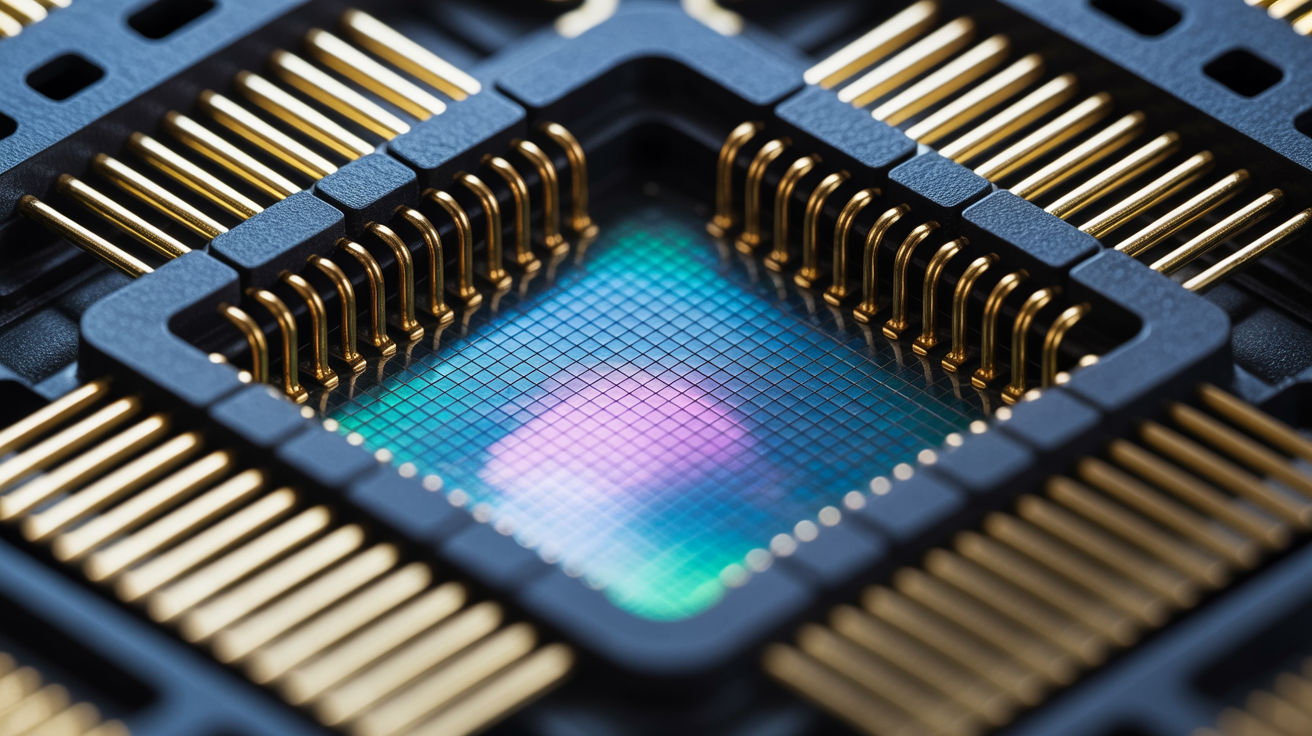
Light reaching a digital sensor is not converted into voltage uniformly across all wavelengths. The Quantum Efficiency (QE) \eta(\lambda) represents the fraction of incident photons that successfully liberate electron-hole pairs inside the silicon depletion region.
The Silicon Bandgap Threshold
Crystalline silicon has an indirect bandgap of E_g \approx 1.12 \text{ eV} at 300K. This establishes a hard physical cutoff wavelength:
\lambda_c = \frac{hc}{E_g} \approx 1,107 \text{ nm}
Photons with wavelengths longer than 1107 nm do not possess sufficient quantum energy to excite valence electrons into the conduction band, rendering silicon completely transparent to short-wave infrared (SWIR) light.
export function computePhotocurrent(
  photonFluxPerNm: Float32Array,
  qeCurve: Float32Array
): number {
  let electronsPerSec = 0;
  for (let i = 0; i < 81; i++) {
    electronsPerSec += photonFluxPerNm[i] * qeCurve[i];
  }
  return electronsPerSec * 1.602176634e-19; // Amperes
}

Beyond RGB Tristimulus: Continuous 6500K Solar Illuminant Simulation
Why three arbitrary RGB primaries inevitably fail physical light transport, and how 81-channel spectral power distributions solve metamerism.


Non-Linear Sellmeier Dispersion in Hardware Raytracing
Implementing wavelength-dependent refractive index equations directly inside GPU intersection kernels.

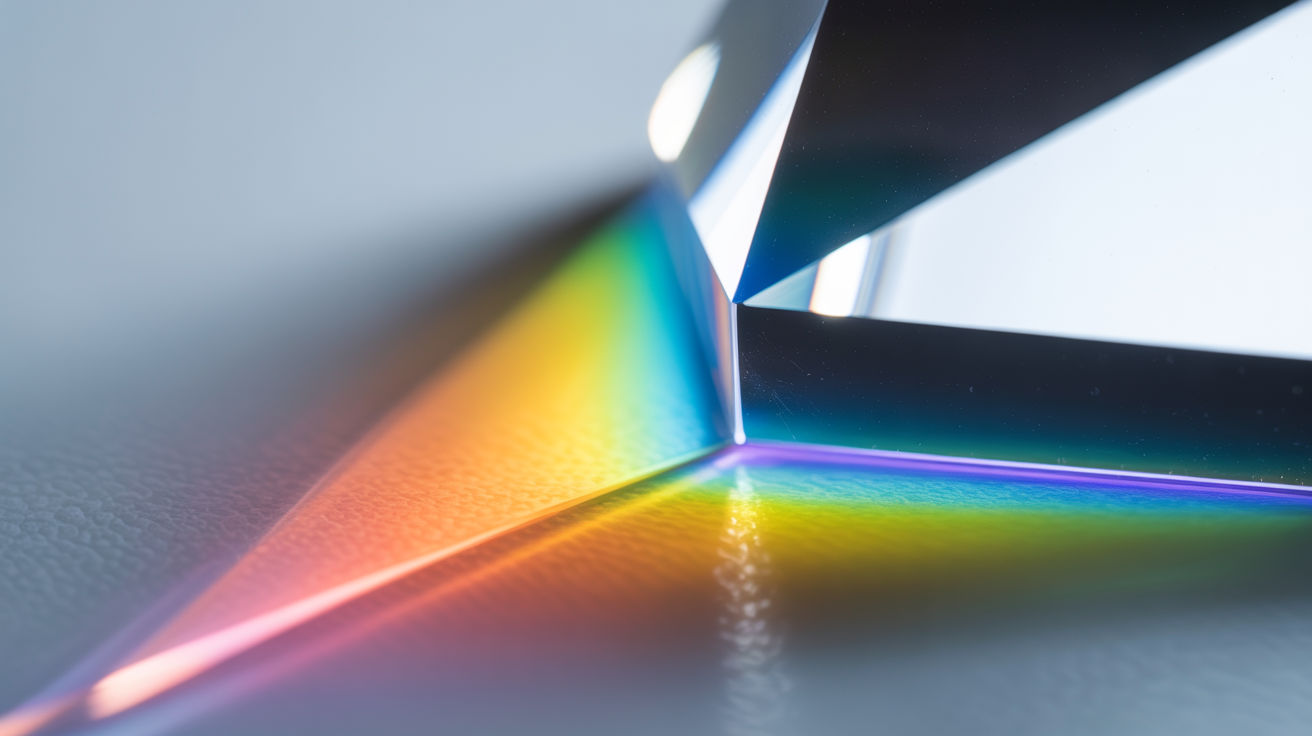
Newton’s Crucial Experiment Recomputed: Crown vs. Dense Flint Prisms
Re-evaluating historical dispersion geometry using contemporary electromagnetic wave propagation and wavefront analysis.