Newton’s Crucial Experiment Recomputed: Crown vs. Dense Flint Prisms
Re-evaluating historical dispersion geometry using contemporary electromagnetic wave propagation and wavefront analysis.

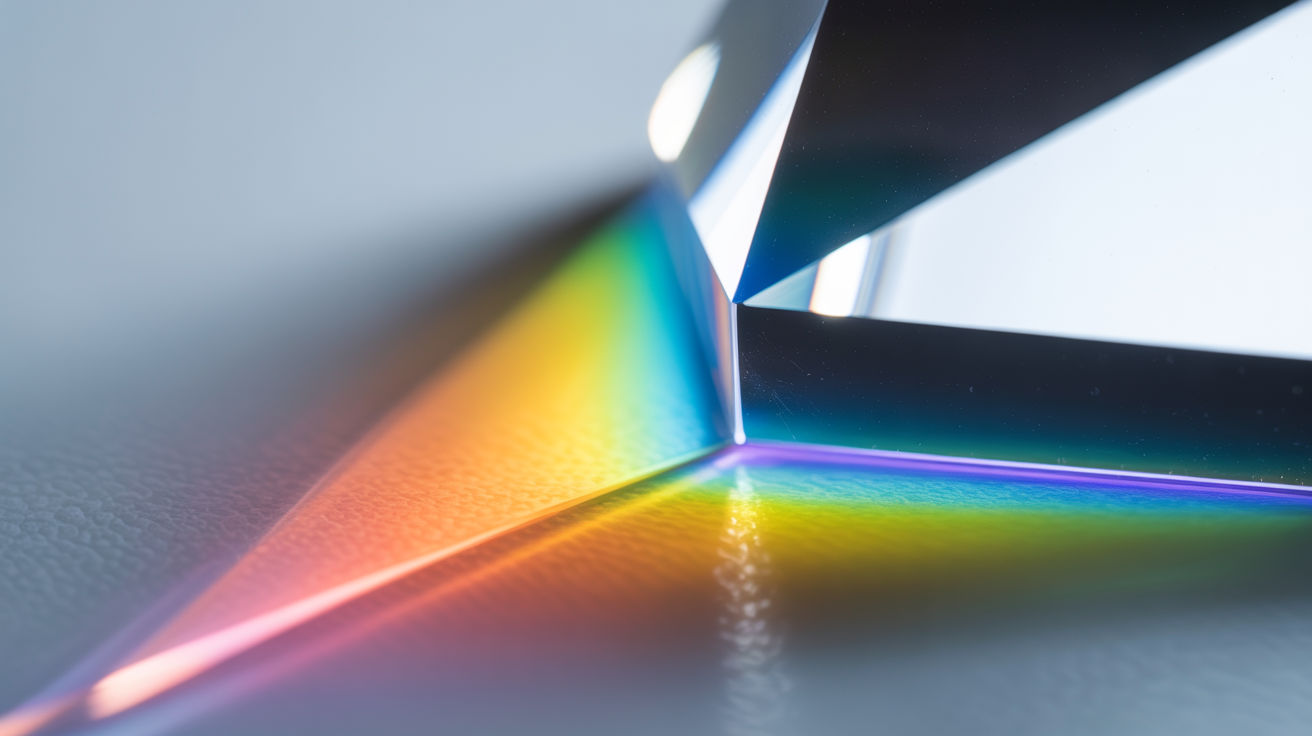
In 1672, Isaac Newton communicated his landmark paper to the Royal Society detailing the Experimentum Crucis. By passing a single dispersed spectral color from a first prism through an aperture into a second prism, Newton proved that color was not a quality imparted by glass, but an innate, immutable property of light itself.
Over 350 years later, we re-examine this experiment using digital spectral solvers.
Abbe Number and Chromatic Dispersion
Different glass chemistries exhibit radically different dispersion slopes. The Abbe number V_d quantifies this behavior:
V_d = \frac{n_d - 1}{n_F - n_C}
Where:
n_dis the refractive index at the Helium d-line (587.56 nm)n_Fis the Hydrogen F-line (486.13 nm)n_Cis the Hydrogen C-line (656.28 nm)
| Substrate | n_d | Abbe V_d | Dispersion Character |
| :--- | :--- | :--- | :--- |
| N-BK7 Crown | 1.5168 | 64.17 | Low dispersion, high transmission |
| SF11 Flint | 1.7845 | 25.76 | High dispersion, broad rainbow band |
| Fused Silica | 1.4585 | 67.82 | Deep UV to near-IR transparency |
In the Solis interactive apparatus, users can toggle between N-BK7 and SF11 to observe the dramatic broadening of the 400nm–700nm projection angle.
Beyond RGB Tristimulus: Continuous 6500K Solar Illuminant Simulation
Why three arbitrary RGB primaries inevitably fail physical light transport, and how 81-channel spectral power distributions solve metamerism.

Non-Linear Sellmeier Dispersion in Hardware Raytracing
Implementing wavelength-dependent refractive index equations directly inside GPU intersection kernels.

Absolute Photopic Luminance: Bridging Radiometry and Human Perception
How physical radiometric watts per steradian convert to perceptual candelas using the CIE 1931 photopic luminous efficiency curve.